Medical Device Division
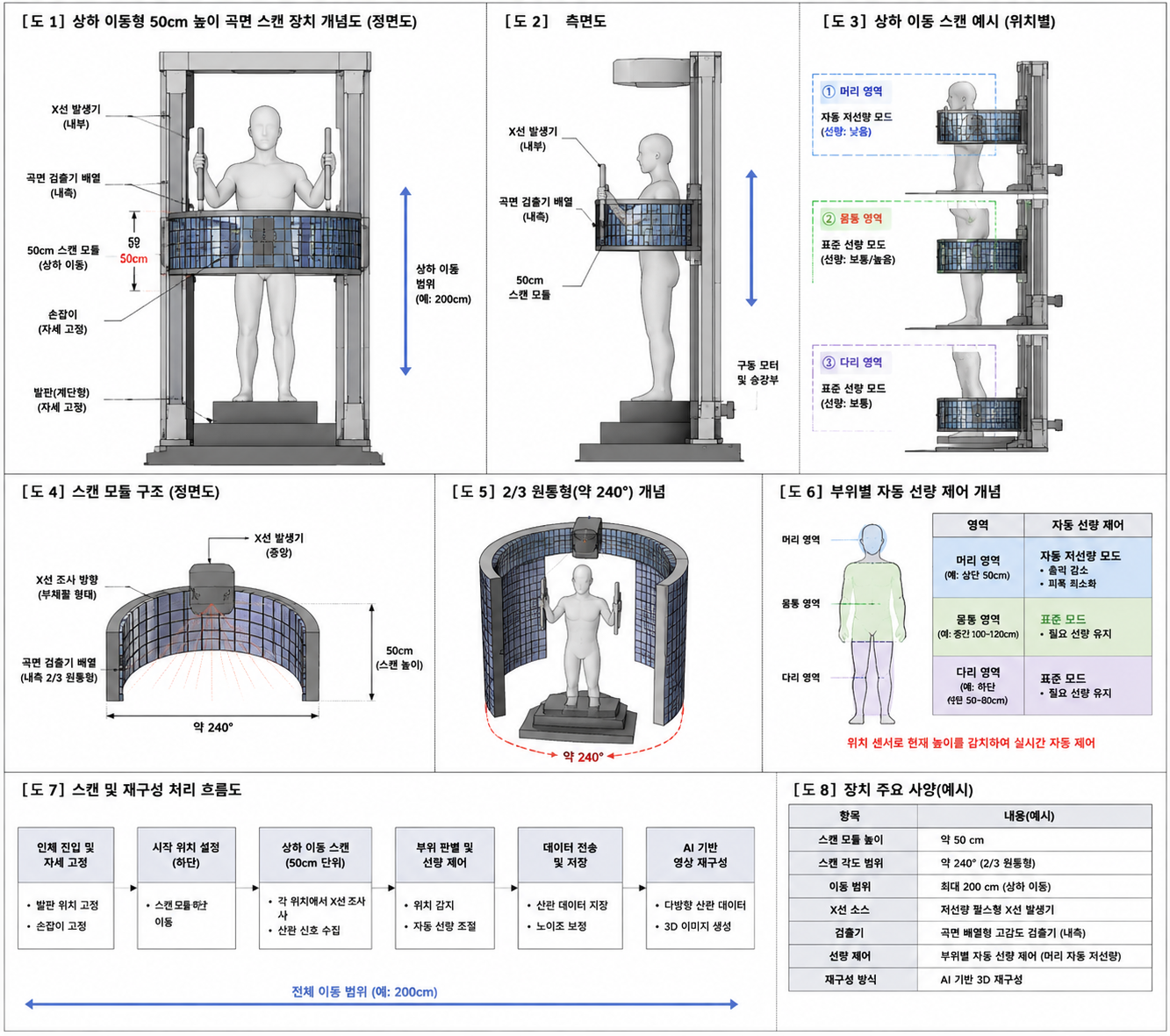
Open gantry and vertically moving image acquisition structure
This technology uses a C-shaped or U-shaped open gantry arranged along part of the examinee’s body circumference and acquires radiation projection data while moving the gantry vertically along the body length.
Multiple radiation emission modules or irradiation channels are distributed around the gantry, so the system is designed to individually control multiple low-output irradiation channels instead of using one central high-output irradiation point.
Simulation
Vertically Moving Scan Simulation
This shows a structure in which a 50 cm curved scan module moves along the body length of the examinee and sequentially scans the head, torso, and leg regions.
A position sensor detects the current height, and the AI-based controller automatically adjusts the dose mode and irradiation channels by body region.
Core Technology Direction
C-shaped or U-shaped open gantry
Configured to acquire radiation projection data including the rear body area without completely enclosing the entire body circumference of the examinee.
Vertically moving irradiation structure
As the gantry moves along the body length and acquires data corresponding to each irradiation section, it can be expanded into whole-body or region-specific examination structures.
AI-based controller
Controls irradiation conditions and image reconstruction conditions based on body information, irradiation section, examination purpose, and irradiation history.
Operation Flow
Application Fields
Medical Imaging Devices
Can be reviewed as a device for general radiographic imaging, low-dose examination, and region-specific customized image acquisition.
Nuclear Medicine and Hybrid Imaging
Can be expanded into a combined radiation projection data structure using gamma rays or a combination of X-rays and gamma rays.
Industrial Non-Destructive Testing
The open gantry and moving irradiation structure can be applied not only in medicine but also to non-destructive testing equipment.
Commercialization Considerations
Technical Verification
Step-by-step verification is required to determine whether radiation generation, detection, shielding, movement, and image reconstruction structures are feasible in real environments.
Standards and Safety
Medical device standards such as radiation safety, electrical safety, software validation, and user protection structures should be reviewed.
Patents and Cooperation
Secure rights to the core structure and establish joint development structures with medical imaging equipment manufacturers, research institutes, and medical institutions.